
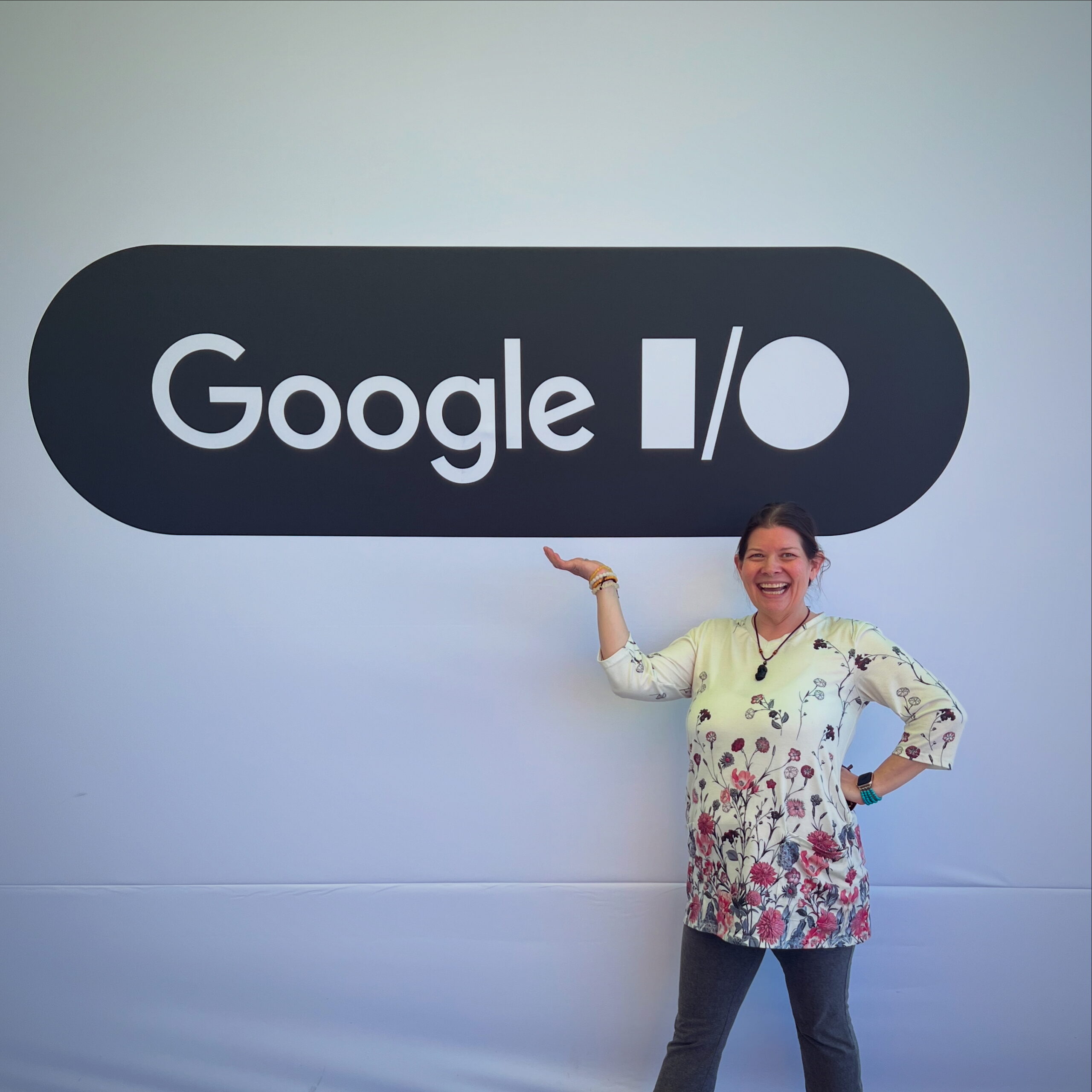
Last year, Google I/O gave me a front-row seat to the conversations shaping the future of search. This year I’m heading back with bigger questions about AI, discovery, and responsibility, plus a sharper set of expectations for what Google is about to announce.
For teams tracking what Google I/O 2026 means for SEO, the signals have been building since last summer. AI Mode is expanding well beyond its U.S. rollout. Generative surfaces are pulling in queries that used to produce reliable blue-link traffic. And measurement still hasn’t caught up with how people are actually finding and acting on information.
After 20+ years in SEO, I’ve learned to watch what Google ships, not just what makes the keynote highlight reel. Below are the five predictions I’m bringing into the week, plus what your team should be doing about each one regardless of how the rollouts shake out.
TL;DR: What to expect from Google I/O 2026 for SEO
- AI Mode becomes the default Search experience. Citation presence is the new average position.
- Gemini gets an explicit seat at the Search table. Source attribution and provenance schema matter more than ever.
- The AI traffic measurement gap narrows. Build a manual AI visibility tracker now, regardless of what Google ships.
- The agentic web goes live. Your structured data is becoming your storefront.
What to do Monday morning: Audit your citation presence across AI Mode, Gemini, and AI Overviews. Document your AI visibility baseline. Get your schema clean and your authors verified.
Why I’m back at Google I/O this year
My first Google I/O invite came through Women in Tech SEO, a community that creates exactly the kind of access that’s otherwise really hard to come by. The highlight of that trip was a structured roundtable with the Google Search team, including Danny Sullivan, alongside other practitioners asking practitioner-level questions about where search is heading. The conversation was candid in a way conference panels almost never are, and it shaped how I’ve thought about AI Overviews, generative content quality, and E-E-A-T signals ever since.
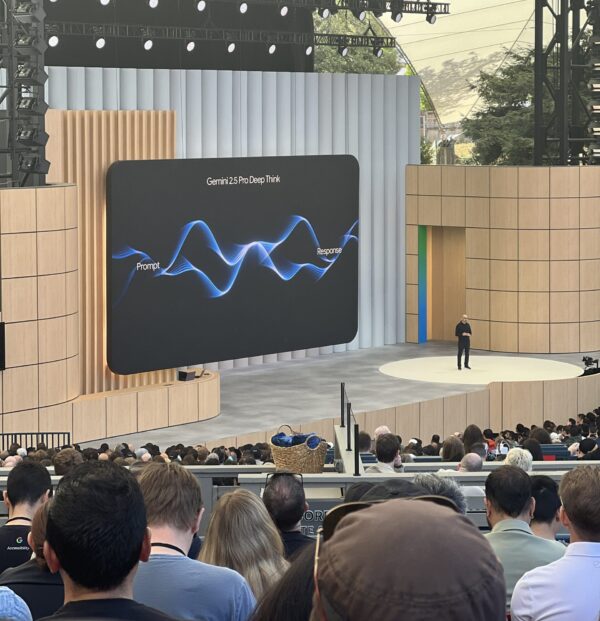
The Shoreline Ampitheater crowd watching the announcements at Google I/O 2025 including Gemini 2.5 Pro Deep Think.
The other part of last year I keep thinking about is getting to spend real time with my friend Jegan Chen. We worked together at an agency years ago, and now he’s at Google on the YouTube user experience team. He gave me a tour through several Google buildings, including his Moroccan-themed office at the time, and honestly, just being inside the spaces where these teams actually work changes how you read every product announcement afterward. The keynote slides start to feel less like marketing and more like decisions made by real people working on real problems.
Bonus: our analyst Ryan Cozart lives right in Mountain View, which is such a gift whenever we head up there. Local read on the energy before the keynote, smoother logistics, and a friendly face every time we’re in town to see Google or other Bay Area partners and clients.
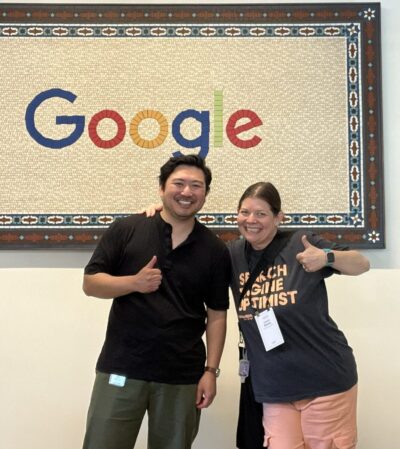
Laura Beatty, CEO of No Bad Days Digital, visiting with long-time colleague Jegan Chen, UX engineer at YouTube.
A few months back, I joined host Oz on the Lead Wolf Talks podcast to talk through what SEO actually looks like in 2026: the shift toward Generative Engine Optimization (GEO), how AI Overviews are reshaping click behavior, why structured data matters more than ever for generative grounding, and how digital PR has absorbed a big chunk of what link building used to cover. That conversation pretty much sums up the lens I’m bringing to I/O this year. Not there to watch demos. There to translate what Google ships into things teams can actually act on.
5 Google I/O 2026 SEO predictions to plan around
1. AI Mode becomes the front door of Search
The biggest shift over the last 18 months hasn’t been algorithmic. It’s structural. AI Overviews trained users to expect a synthesized answer at the top of the page. AI Mode is the natural extension: a persistent conversational layer that handles the query, the follow-ups, and the comparison stage in a single session, often without sending the user back to a traditional results page at all.
I expect Google to announce a meaningfully broader rollout at I/O, with deeper integration across Lens, Shopping, Maps, and YouTube. For enterprise SEOs, the headline is that citation presence is the new average position. You can rank well on paper and still be invisible in the surface where purchase intent now resolves.
Three moves that pay off regardless of how broad the rollout actually turns out to be:
- Run a manual AI Mode sample on your top 100 commercial queries. Search each one in AI Mode and in standard Google Search. Score whether AI synthesis is returned and whether you’re cited (yes/no, prominent/buried). The queries triggering generative answers without citing you are your visibility blind spots. GSC click data won’t catch them.
- Audit content answer-worthiness. Well-sourced, structured, original content earns citations. Thin, derivative content gets passed over entirely. If you can’t tell which of your pages are answer-worthy at a glance, neither can Gemini.
- Stop treating the ten blue links as your only conversion surface. Start optimizing for being the citation source generative systems reach for.
Teams that adapt fastest already have clean content architecture and verifiable source signals in place. If your E-E-A-T signals are underdeveloped, that’s the priority fix above everything else on this list.
2. Gemini gets a deeper seat at the Search table
Gemini has been quietly powering the synthesis layer behind Search for several product cycles. I expect I/O to make that explicit: a named model version driving AI Mode, with grounded responses and (fingers crossed) more transparent citation logic that publishers can actually observe and respond to.
Here’s something we’re seeing across client sites right now: Gemini referral traffic is starting to show up as its own distinct source in analytics, while AI Mode and AI Overview visits often blur into traditional organic. The teams that win the next 12 months are the ones who can tell those streams apart and respond to each one differently.
The bigger question for enterprise content programs isn’t which model is running underneath. It’s whether Google starts exposing source-selection signals to publishers in any meaningful way. Watch for updates to structured data specs for Author, ReviewedBy, and Citation. Google has been quietly favoring content with verifiable provenance in generative grounding, and a formal signal update in that direction would be significant.
Before the keynote, get your team to verify three things:
- Author and Organization schema are implemented accurately and link to verifiable author entities. This is increasingly how generative systems evaluate editorial credibility.
- Your current baseline of AI Overview, AI Mode, and Gemini citation rates across priority URL clusters is documented. You need that baseline before any new reporting surfaces change what you’re measuring.
- If Google announces new GSC features that surface AI citation impressions, fast-track the implementation. First-mover advantage in measurement is real.
Groundwork on source attribution schema is one of those investments where being six months ahead pays real dividends when Google formalizes the signal.
3. The AI traffic vs. organic traffic measurement gap narrows
Every enterprise team I work with is running some version of the same problem: AI Overview impressions show up in Search Console, but the full picture of AI-driven sessions, attribution, and downstream engagement is murky at best. I/O 2026 is the right moment for Google to ship better tooling here, whether that’s a dedicated AI Mode report in GSC, a UTM-style parameter for AI-referred traffic in GA4, or both.
I want this one more than I fully expect it. But watch the developer keynote closely, because even a directional half-step in measurement would reshape how enterprise SEO programs report organic performance to executive stakeholders.
The measurement infrastructure worth building now, regardless of what Google ships:
- A manual AI visibility tracker sampling 50 to 100 high-value queries monthly across AI Mode, Gemini, ChatGPT Search, Perplexity, and Claude. Score citation presence over time, independent of GSC data.
- Custom GA4 events on your top 25 commercial URLs that fire when those pages appear within AI Overview responses. Imperfect, but directionally useful today.
- A dedicated analyst assigned to own this measurement function. By Q4, this becomes one of the most important reporting tracks in the program.
Teams building this infrastructure now won’t scramble when a board or CMO asks “are we showing up in AI search” at year-end planning.
4. Search Console gets an AI-aware glow-up
The current AI Overview reporting in GSC is a foundation, but it’s thin relative to what enterprise teams actually need. I’d be surprised if I/O passed without a meaningful update here.
The table below maps what’s available today against what would actually change how teams report and make decisions:
| Reporting capability | Available today | What enterprise teams need |
|---|---|---|
| AI Overview impressions | Yes, limited | Broken out by AI surface: AI Mode, Lens, Discover |
| Query-level AI data | No | Queries filtered by generative surface |
| Click and CTR from AI surfaces | No | Even directional data would change how teams report performance |
| Citation-level URL tracking | No | Which AI experience cited a specific URL, in response to what query |
Query-level data filtered by AI surface would be the most valuable addition, because it would let teams see which topics are earning AI Mode citations versus which are stuck in traditional blue-link competition. That distinction shapes content investment decisions directly.
Two moves to make the moment any GSC update is confirmed:
- Document your current GSC reporting baseline now, so you have a genuine before-and-after comparison when new data becomes available.
- Treat new AI reporting features as a fast-track implementation task, not a backlog item. First-mover advantage in measurement is real.
5. The agentic web gets real
This prediction covers the most ground and, for enterprise brands, probably carries the highest strategic stakes. Sundar Pichai has explicitly framed Google’s evolving role as moving from information retrieval toward “agent manager,” and the I/O 2026 agenda reflects that. Projects Astra and Mariner have already moved agentic browsing from research prototype to functional demo. I expect I/O 2026 to move several components from demo to developer-ready, with APIs and interaction standards that let sites signal they’re ready to work with agent-driven queries and transactions.
Four developments belong inside this prediction because they describe the same underlying shift: a web increasingly designed for machine-mediated discovery and commerce, not just human navigation.
Universal Commerce Protocol (UCP). Google’s UCP, currently rolling out in Merchant Center, lets users complete full purchases inside AI Mode without being redirected to a retailer’s site. When an agent handles the transaction, you’re no longer optimizing for a click. You’re optimizing to be the entity the agent trusts with the purchase. For ecommerce teams, that fundamentally relocates where conversion optimization happens.
AI-generated landing pages. Google patent US12536233B1 describes a system where AI evaluates a landing page’s conversion rate, bounce rate, and design quality, then replaces underperforming pages with AI-generated, personalized versions. The implication for enterprise marketing is direct: your structured data, product feeds, and API surfaces are becoming your primary storefront. The human-designed landing page is, in some scenarios, conditional on performance.
Audio Overviews and Ask YouTube. Google is testing Audio Overviews that generate a conversational two-person podcast format in response to search queries, with a broader rollout potentially timed to I/O. Ask YouTube is testing a conversational interface where a planning query returns a structured mix of long-form videos, Shorts, and informational text rather than a standard video list. Both are new citation surfaces where traditional click-through metrics are largely beside the point.
Getting ahead of the agentic web requires cross-functional alignment that SEO teams rarely drive on their own, but these are the right starting points for Monday morning:
- Audit your Product, Offer, Organization, and BreadcrumbList schema for accuracy and completeness. This is the data layer agentic systems read first.
- Test how a headless browser renders your key conversion pages. JavaScript-heavy checkout flows are where agentic handoffs break down most often.
- Start the UCP and Merchant Center readiness conversation with engineering and product now. The window to get ahead of this is narrowing faster than most roadmaps reflect.
- Review your YouTube metadata, chapter structure, and transcripts for Ask YouTube readiness. Semantic structure matters there exactly the way it does in traditional search.
If SEO is the only team in the building having this conversation, the organization is already behind.
What this all adds up to
The story coming out of I/O this year isn’t that AI is coming for search. That already happened. The actual story is that the measurement framework, the migration playbook, and the optimization surface are all getting material upgrades in the same week, and the teams positioned to benefit are the ones who already did the foundational work.
Citation presence is the new average position. Generative Engine Optimization isn’t a replacement for technical SEO fundamentals. It’s what becomes possible when those fundamentals are already solid and you build deliberately on top of them. The enterprise brands that understand that distinction heading into this event are the ones that will extend their lead while others are still orienting to the new surface.
One more thing I’m watching for
Beyond the product announcements, I’m hoping Google takes time at I/O to address the responsibility dimension of this transition. Not as a positioned statement, but as a substantive conversation about deployment guardrails, data sourcing, and accountability at scale.
The questions I most want answered aren’t purely technical. How is data being collected, weighted, and surfaced in generative responses? How are publishers and content creators factored in when their work trains and grounds these systems? How are AI data centers positioned in the broader infrastructure and energy conversation? And for enterprise brands specifically: when an AI agent completes a transaction on a user’s behalf and something goes wrong, what does the accountability framework look like in practice?
Over twenty years in SEO, I’ve watched Google reshape entire business models, sometimes with adequate notice and sometimes without. The pace of change with generative AI is faster than anything that came before it. I’ll be listening this week not just for what Google can do with these systems, but for how clearly the company can articulate what it intends to do, and how it’s thinking about the publishers, brands, and users that depend on the ecosystem remaining trustworthy. That’s the conversation I most want to be in the room for at Shoreline.
I’ll be sharing real-time reactions throughout the week on No Bad Days Digital on LinkedIn and on Instagram. If you’re an enterprise SEO leader working through what these announcements mean for your team’s roadmap, reach out to schedule a post-I/O strategy session. No panic. No worries. Just the plan.
See you on the other side of the keynote. 🌴
About the author: Laura Beatty is the founder of No Bad Days Digital, a boutique SEO consultancy focused on technical SEO, high-stakes site migrations, and AI search strategy. Her career has included enterprise SEO experience on brands such as HP, Microsoft, Mastercard, and David Yurman through prior agency engagements.