
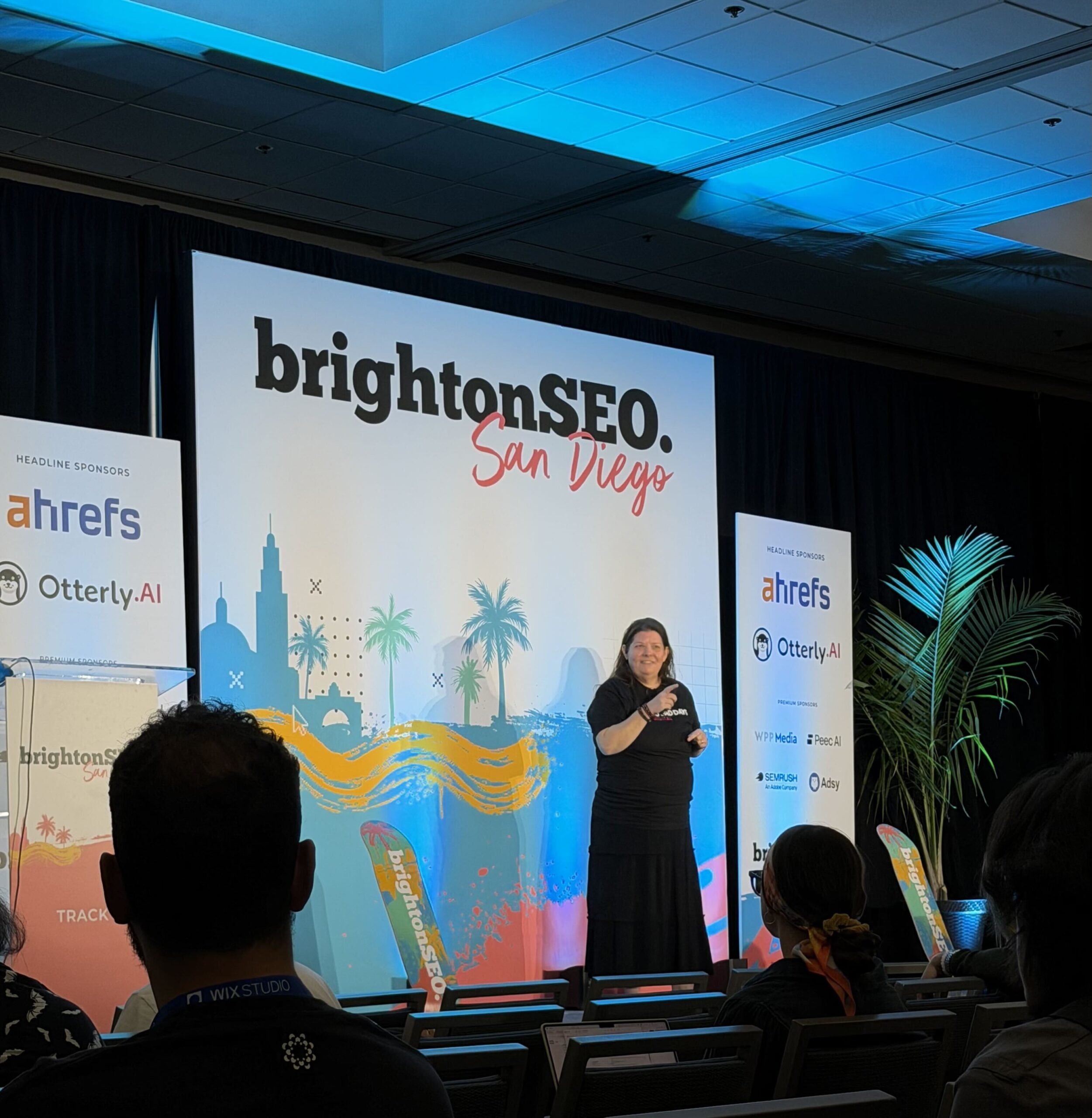
I just returned from speaking at The brightonSEO Conference at the San Diego Convention Center, and as you can probably imagine, AI was everywhere.
Everyone in search is trying to understand what AI Overviews, LLMs, agents, and changing discovery habits mean for the future of our industry. There are new tools to measure AI visibility, new optimization strategies emerging almost daily, and plenty of predictions about where search is headed next.
I’m fascinated by all of it, but I left the conference thinking about a different question:
Are we focusing so much on AI that we’re losing sight of the places still driving meaningful traffic and the principles that made good SEO work in the first place?
We’re trying to optimize for an environment that is changing in real time. User adoption is evolving, the models themselves are evolving, and our ability to measure the impact of AI visibility is still imperfect. That makes it difficult for enterprise organizations to know which new strategies deserve their attention and which may look very different six months from now.
I don’t think the answer is to ignore what’s changing. It’s to understand those changes while staying grounded in the things that aren’t changing: knowing your audience, making information easy to understand, creating useful experiences, and giving people the information and proof they need to make a decision.
What’s becoming much more interesting to me is the role SEO can play in bringing all of that together.
SEO Is Becoming Brand Orchestration
After attending Google I/O earlier this year, I came away thinking about how search was becoming more ubiquitous. brightonSEO reinforced that idea for me.
The search journey is no longer contained within a search engine. Someone researching your company might find you through Google, ask ChatGPT about your category, read your reviews, see a discussion about you on Reddit, hear your CEO on a podcast, watch a video, visit your website, compare competitors, and return later through another channel.
For enterprise organizations, SEO can’t operate effectively in a silo anymore. I think our role is becoming much closer to brand orchestration.
SEO teams have a unique view into what people are looking for, how they talk about a category, where they encounter a brand, what questions they ask, and where gaps exist. That gives us an opportunity to work across content, PR, product, development, brand, sales, customer success, and other teams to create a clearer and more consistent experience wherever discovery happens.
That’s a very different role from the traditional idea of an SEO running an audit and handing another department a list of technical recommendations. As search becomes more fragmented, our value increasingly comes from understanding how all of these pieces work together and helping organizations decide what to do about them.
Enterprise SEO Is Increasingly About Prioritization
One thing I hear again and again from clients is that they have more information than they know what to do with.
There are analytics platforms, SEO tools, AI visibility trackers, competitive reports, technical audits, content recommendations, PR opportunities, new channels, and a constant stream of advice about what brands should be doing next.
Most enterprise teams don’t have a shortage of ideas. They have finite time, budgets, and resources, which makes prioritization much more important.
One pressure test I keep coming back to is: Would we still recommend doing this if SEO didn’t exist?
Would this content help someone make a decision? Would improving this page create a better customer experience? Would getting an executive onto the right industry podcast strengthen the company’s authority in an area it wants to own?
Would stronger customer reviews give prospective buyers useful proof? Would participating in a conversation within your industry add something genuinely valuable?
If the answer is yes, there’s a good chance you’re investing in something that has value beyond a temporary ranking opportunity.
This is one of the reasons I think experienced SEO partners become more important, not less, as AI changes search. The value isn’t in identifying every possible thing an organization could optimize. It’s in helping teams understand what will have a meaningful impact, what supports the larger business, and what is likely to stand the test of time.
AI Is Making Human Judgment More Valuable
Another thing I’ve been thinking about since brightonSEO is how AI is changing the actual work marketers do.
We talk a lot about the efficiencies AI creates, and those efficiencies are real. It can accelerate research, ideation, drafting, analysis, and production. At the same time, faster creation gives us much more to evaluate.
In some ways, marketers are becoming QA engineers as much as creators.
When you create something from scratch, it’s fairly easy to get into a flow. Reviewing AI-assisted work requires a different kind of concentration because you’re constantly evaluating what’s in front of you. Is it accurate? Is it useful? Does it add anything? Is it consistent with the brand? Does it actually answer what the audience needs to know?
As organizations adopt AI at scale, I think learning how to make those judgments well will become increasingly important.
AI can help us produce more, but producing more isn’t automatically a competitive advantage. If everyone has access to the same tools, judgment becomes a differentiator. Knowing what deserves to be published, what needs more work, and what shouldn’t exist at all still requires expertise.
More Information Doesn’t Always Make Decisions Easier
There’s an interesting contradiction happening as AI becomes part of how people search.
We often talk about AI as a way to simplify information. Instead of opening ten search results, someone can ask a question and receive a synthesized answer almost immediately.
But that doesn’t necessarily make decision-making simpler.
People can now ask more questions, explore more nuances, compare more options, and go much deeper into a topic. AI can help narrow the path, but it can also introduce an enormous amount of new information to consider.
For brands, that makes clarity even more important.
People still need to understand what you do, why it matters, how you’re different, whether they can trust you, and what they should do next. They don’t want to work harder than necessary to find those answers.
Clear information architecture, scannable content, credible proof points, useful answers, and an intuitive journey aren’t becoming obsolete because of AI. They become more valuable when your audience has even more information competing for its attention.
What Happens to Websites in an AI-Driven World?
One of my favorite moments at brightonSEO happened outside of the formal sessions. I ran into keynote speaker, Co-Founder and CMO of Orbit Media Andy Crestodina in one of the lounges before his talk, and we ended up having a great conversation about website migrations, headless CMS platforms, and eventually a much bigger question: What happens to the CMS when AI agents can build websites?
We’re already seeing people experiment with agentic coding and AI-native web development. In theory, you can imagine companies bypassing traditional content management systems and using AI and code to manage more of their web presence directly.
I’m not convinced most organizations are there yet, particularly at the enterprise level.
A CMS isn’t simply a place to publish a page. It provides structure, governance, workflows, consistency, editing capabilities, and guardrails. Those things tend to become more important as an organization and its website become more complex.
I expect we’ll see plenty of experimentation with AI-native websites over the next few years. I also suspect we’ll see some companies build their own websites, break their own websites, and eventually need experts who understand how content, technical SEO, UX, architecture, development, and governance work together to help sort them out.
It’s an interesting example of why I don’t think AI makes SEO expertise less necessary. It changes where and how that expertise is needed.
SEO Shouldn’t End With the Click
Another shift I think we need to make is expanding the way we think about SEO’s role in the customer journey.
Historically, SEO has been treated primarily as an acquisition channel. We get someone to the website, generate the click, and hopefully move them into the funnel. That definition is becoming too narrow.
Images, video, forums, Q&A content, reviews, social content, customer communities, podcasts, third-party mentions, and other experiences can all influence how someone understands and feels about a brand. They also contribute to the larger ecosystem of information available about a company.
We often spend enormous amounts of energy trying to gain visibility in someone else’s community while overlooking the expertise, customers, assets, and conversations we already have.
SEO teams can help organizations recognize those opportunities and connect them. Organic strategy can contribute to trust, retention, and referral in addition to acquisition, which is another reason I think the future of SEO looks increasingly like brand orchestration.
What I’m Taking With Me From brightonSEO
I expect search to look very different a few years from now. AI platforms will evolve, measurement will improve, websites will change, new discovery channels will emerge, and some of the tactics we rely on today will become less important.
We should be experimenting with those changes. We should understand how our customers are using AI search, pay attention to where visibility is shifting, and continue testing what works.
But preparing for the future doesn’t mean abandoning what we already know.
For enterprise organizations, the bigger opportunity is to build an ecosystem where your brand is easy to find, easy to understand, and consistent wherever people encounter it. That requires more than optimizing a page for a keyword or trying to reverse-engineer the latest AI model. It requires teams to work together, understand what their audiences actually need, and make smart decisions about where to invest.
That’s probably my biggest takeaway from brightonSEO this year. Search is becoming more complex, but the goal isn’t. We’re still trying to connect people with useful information, help them understand what matters, and make it easier for them to make a decision.
How we accomplish that will continue to evolve, and I think SEO has an increasingly important role in helping organizations connect all of those pieces.
Want a Copy of My brightonSEO Presentation?
My session at brightonSEO San Diego was called, “How to Prune, Shape, and Replant Your Content So Your SEO Thrives After a Redesign.”

Here I am with the ukuleles I gave out during my talk
I used the story of a banana tree that has been in my family for decades to explore something we see frequently in enterprise SEO: good content doesn’t necessarily stop being valuable because its environment changes. A redesign, CMS migration, changing SERPs, AI Overviews, or new site architecture can completely change the conditions around content that took years to build.
In the presentation, I walk through the framework we use to evaluate content based on its performance, potential, purpose, and experience before deciding whether it should be retained, refreshed, consolidated, redirected, or retired.
If you’re planning a website redesign, migration, or major content cleanup, contact me on LinkedIn to get a copy of my brightonSEO presentation.
Laura Beatty is the CEO & Co-Founder of No Bad Days Digital. She works with enterprise organizations navigating complex website redesigns, migrations, content strategy, and SEO in an evolving search landscape.
One Comment
Comments are closed.
[…] shared some of my thoughts on AI, brand orchestration, and where search is headed in my blog post, My Takeaways From brightonSEO on the Future of SEO in the AI Age. This time, I wanted to talk about the people who made the week so much […]