
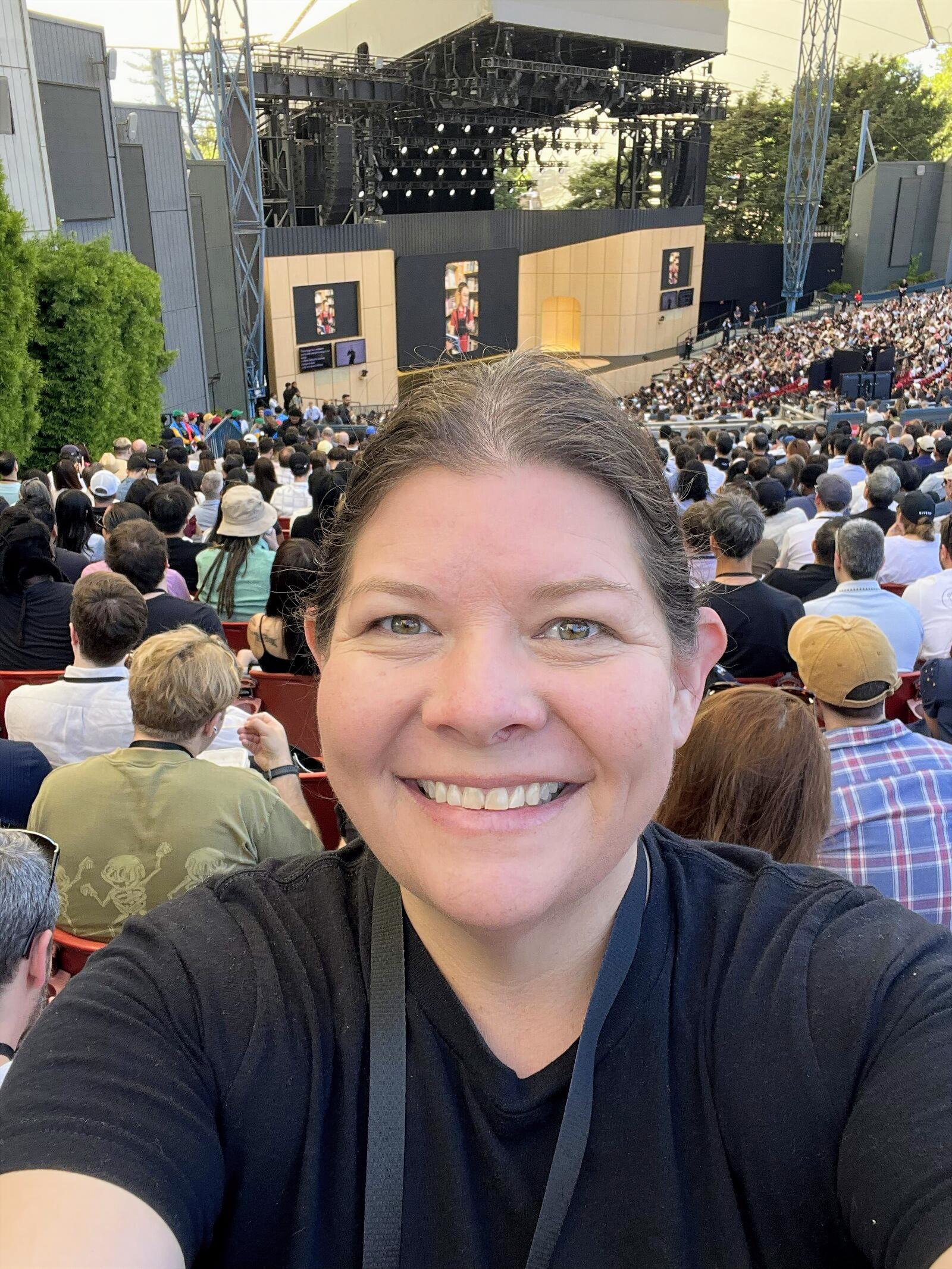
The Most Exciting Hour at Google I/O 2026 Wasn’t About Search; It Was About Quantum AI
The session was called “Building the quantum-AI future.” The presenters were Hartmut Neven, who leads Google Quantum AI, and James Manyika, Google’s SVP of Research, Technology, and Society. I walked into Shoreline Amphitheatre expecting another well-produced keynote with polished slides, benchmark numbers, and a cinematic sizzle reel about the decade ahead.
Twenty minutes in, I knew something different was happening.
The Google I/O 2026 quantum computing session was not necessarily aligned for someone like me who runs an enterprise SEO program. The AI Mode sessions covered territory much closer to my day-to-day work, and the full tactical layer is in my Google I/O 2026 recap if you want that first. But the quantum session was the most interesting hour of the conference, and I have been turning it over in my head since I got home.
Not because it changed anything in particular right now. The reason I walked out more energized than from any other session that week is that the ideas Neven put on that stage connect threads I have been pulling at for most of my career, and the picture they form together is genuinely worth any digital leader’s attention, even one whose entire focus is organic search.
What follows covers what Google actually announced, why it connects to a pattern of thinking that runs well beyond enterprise technology, and what a practitioner with over twenty years inside search systems thinks you should take from a session that looked, on paper, like it had nothing to do with your work. The full Google I/O 2026 keynote on YouTube has the complete context if you want to watch the session yourself.
TL;DR: Notes from the Google I/O 2026 quantum session
- Willow cracked a 30-year physics problem. As the 105-qubit processor scaled up, error rates fell exponentially rather than compounding. Below-threshold quantum error correction is real, in hardware, today.
- Quantum Echoes is the first verifiable quantum advantage on actual hardware. Running 13,000x faster than a classical supercomputer at molecular-structure mapping, with results a classical scientist can independently verify.
- What this enables: atomic-precision cancer drug design, solid-state batteries that charge in minutes, and enzyme simulation that could change global agriculture.
- The deeper pattern: from Pirsig’s framing of quality, to Katya Walter’s mapping of I Ching hexagrams to DNA codons, to the “It from Qubit” hypothesis, quantum is formalizing in mathematical language a pattern-recognition story humans have been telling across philosophy and physics for decades.
What it means for SEO leaders: nothing tactical today. But the research agenda funding Willow is the same one funding AI Mode and whatever succeeds it.
What Google actually announced
Three things came out of the Neven and Manyika session to understand before the broader framing gets layered on top.
The Willow processor and below-threshold error correction
The Willow chip is a 105-qubit quantum processor. That number alone means little without context. The significant thing about Willow is not the qubit count; it is what Google’s team proved happens as that count scales up.
Every classical computer, from a pocket calculator to a supercomputer, operates on binary bits: a value is either 0 or 1. Quantum computers operate on qubits, which can hold a superposition of both states simultaneously. That property makes them extraordinarily powerful for certain classes of problems. The catch has always been error rates. Qubits are fragile, and as you add more of them, errors compound. More qubits historically meant more noise, and the field spent nearly 30 years trying to solve that fundamental problem.
Willow crossed the threshold. Google demonstrated that as they scaled the number of physical qubits, the system’s error rate decreased exponentially rather than compounding. “Below threshold” is the technical term for that crossover point: the moment at which adding more qubits makes the system more reliable, not less. Cracking that problem after three decades of effort is the foundational achievement that the rest of the announcement rests on.
The benchmark Google cited makes the scale of the performance gap visceral. Willow completed a specific computation in under five minutes that would take the world’s fastest classical supercomputer 10 septillion years. That number is not a rounding error. Ten septillion years dwarfs the current age of the universe by a factor that is itself nearly incomprehensible.
Quantum Echoes and verifiable quantum advantage
“Quantum advantage” has been claimed before. The challenge with previous claims was that the benchmark tasks were designed specifically to make quantum computers look good on problems classical machines were never built to solve. Skeptics called those benchmarks contrived, and they had a point.
Quantum Echoes is different because it runs on a real-world problem: mapping the structures of molecules using Nuclear Magnetic Resonance (NMR) data. The molecular-ruler analogy Neven’s team used is apt. The algorithm reads NMR data and reconstructs molecular geometry at atomic precision. Quantum Echoes ran 13,000 times faster than a classical supercomputer on that task, and critically, the results can be verified independently by classical scientists. A real researcher can check the answer against known molecular structures. The claim is not self-referential, which is precisely what makes it a genuine milestone rather than a marketing headline.
The applied science pipeline is opened
Neven and Manyika were deliberate about the timeline framing. The headline is not “this ship’s next quarter.” The headline is “This is what becomes possible now.” The domains they named are worth sitting with:
- Cancer drug design at atomic precision, with the ability to simulate how a molecule will behave inside the human body before synthesizing it in a lab
- Solid-state batteries that charge in minutes, enabled by simulating the electrochemical behavior of materials at a scale that classical computers cannot approach
- An enzyme simulation that could meaningfully change global agriculture, including how nitrogen fixation works and what that means for fertilizer dependency worldwide
Each of these applications depends on the molecular-scale simulation that Quantum Echoes makes possible. None of them is science fiction. All of them are on a timeline measured in years rather than decades, now that below-threshold error correction has been demonstrated in actual hardware.
That was the news. The reason I walked out of the session more energized than from any of the AI Mode presentations is connected to a pattern I have been turning over in my head for years.
The pattern underneath the news
Neven said something early in the session that opened a door I had not expected to walk through at a tech conference. The quote, as closely as my notes captured it: “Quantum mechanics is not just the physics of the microscopic world; it is the law of the land at all scales.”
The pattern-recognition thread from physics to philosophy
Quantum computing embraces a counterintuitive premise: what looks like chaos or noise at one scale is not randomness. It is an intricate, information-dense order that classical instruments are too coarse to read. The field’s entire project is building instruments fine enough to see the structure underneath the apparent disorder.
That maps to something Robert Pirsig was circling in Zen and the Art of Motorcycle Maintenance: the idea that quality is a pattern recognizable across domains, independent of the medium it appears in. The underlying move, which looks like subjective chaos, resolves into legible structure when you develop the right kind of attention, is structurally the same argument. The instinct that order underlies apparent disorder, and that developing better instruments for perceiving it is the most important kind of work a person or a field can do, runs through both physics and philosophy.
The Katya Walter and I Ching layer
In The Tao of Chaos, Katya Walter mapped the 64 hexagrams of the I Ching to the 64 codons of human DNA, arguing that the universe behaves as a massive fractal supersystem where the same organizational patterns repeat across wildly different scales and domains. The I Ching hexagrams were developed over millennia as a pattern-recognition system for understanding how situations evolve. Human DNA is the information architecture that specifies biological life. Walter’s observation was that the structural logic of one maps cleanly onto the structural logic of the other.
That is not a mystical claim. It is an observation that rigorous ancient pattern-recognition systems and modern molecular biology keep arriving at structurally similar descriptions of how information organizes itself. Quantum information theory is now formalizing the same phenomenon in mathematical language: information as the substrate, pattern as the organizing principle, scale as something the underlying rules do not much care about.
When Neven says that quantum mechanics is the law of the land at all scales, he is, in a different register, making the same observation Walter was making.
The “It from Qubit” hypothesis
The bleeding edge of quantum information theory holds that physical reality and spacetime are not fundamental. The hypothesis, associated with physicist John Archibald Wheeler and extended by researchers working on holography and quantum gravity, proposes that what we experience as matter, space, and time are emergent properties woven together by quantum entanglement.
The shorthand is “It from Qubit”: the universe might not be made of “stuff” at its foundation. It might be made of information, and entanglement might be the relationship that information uses to assemble itself into what we experience as physical reality. The phrase is Wheeler’s, the formalization is ongoing, and the Google Quantum AI research program is working at the edge of that question with hardware rather than just theory.
What the Willow announcement actually demonstrated, beyond the technical milestone, is that the tools we have for observing the universe’s pattern-recognition rules are getting sharp enough to see structure where we used to see noise. That changes what is possible across every field that depends on pattern recognition. Including, eventually, search.
What this enables, in plain English
The philosophical layer matters because it explains why Willow represents a directional shift rather than a product update. The applied implications are worth naming concretely so the distance between now and then feels real rather than abstract.
Quantum machine learning efficiency
Classical AI models of the kind that power Google Search, Gemini, and the AI Mode features announced elsewhere at I/O 2026 require enormous infrastructure to train. The data centers involved consume power at a scale that is genuinely constraining the pace of AI development. The reason the capability curve has been so steep in recent years is that raw compute, measured in classical terms, has been growing fast enough to fund it. That growth has physical limits.
Quantum machine learning promises exponential efficiency for specific classes of pattern-recognition problems: the combinatorial explosions of possibility space that are simply invisible to binary logic. When quantum hardware and AI architectures fully converge, AI systems will be able to process pattern spaces that no classical data center could approach, not because the data centers grew larger, but because the underlying compute model changed. The shift is qualitative, not quantitative.
Quantum-generated training data
The limiting factor in modern AI is increasingly training data quality, not raw compute. Models like Gemini and GPT-4 have already absorbed most of the high-quality human-generated text on the open web. The next frontier is synthetic training data that is complex, structured, and physically accurate enough to teach AI systems about domains like molecular biology, materials science, and fluid dynamics at a level of precision that human-written text cannot support.
Quantum computers are particularly well-suited to generating exactly that kind of data. A quantum simulation of a protein-folding process or an electrochemical reaction produces a training dataset that reflects the actual physics of the system, not an approximation. That raises the ceiling of what AI can learn, and by extension, what it can do in applied settings far removed from drug discovery or battery chemistry.
Implications for how search systems evolve
The web of the future will be parsed not just by text-matching algorithms but by AI systems trained on data that reflects physical and informational reality at a precision current systems cannot reach. That is a ten-year horizon, not a Q3 roadmap item. But the direction is clear. Google’s investment in quantum research is not separate from its investment in AI search. The same organization building the search environment your business depends on is also funding the science that will define how machines understand the world in the next generation of systems.
The through-line from Willow to AI Mode to whatever succeeds AI Mode is a single research agenda, not three separate product bets.
Why this mattered to me, and what it might mean for you
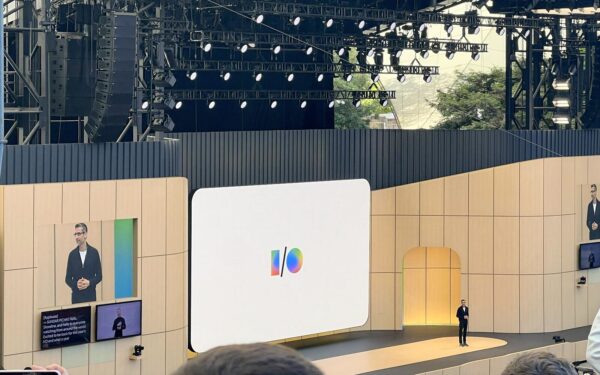
Sundar Pichai opens Google I/O 2026 at Shoreline Amphitheatre.
I have spent over twenty years in SEO watching pattern-recognition systems get progressively better at understanding what content means, who it serves, and how it connects to everything else on the web. The early years were about exact keyword matching. Then came semantic similarity. Then, latent intent modeling. Now, with AI Mode, Google is attempting to synthesize patterns across documents, user histories, and real-world context at a scale that would have seemed implausible a decade ago.
The Willow announcement is a milestone in that same story, told at a much smaller physical scale and in a much more rigorous mathematical language. The work Neven’s team is doing in a quantum lab, and the work I have been doing inside search systems are, structurally, the same kind of work: making patterns legible to systems that can act on them. That is not a reach. It is the actual description of both fields.
Manyika noted during the session that Google Search itself started as a moonshot. The people who built PageRank were not thinking about ad revenue or enterprise software contracts. They were trying to make the web’s link structure legible as a signal of authority and relevance. The relationship between that original moonshot and what Google does at scale today is the same relationship as the one between Willow’s current capabilities and the search systems that will be running in 2035.
You do not need to understand qubits to do strong SEO work in 2026. But the practitioners who pay attention to what Google is funding alongside the products it ships will be better positioned five and ten years from now than the ones who treat the keynote as the whole story. The Hartmut Neven session at Google I/O was the rest of the story, and it was worth every minute of the hour.
My Google I/O 2026 recap covers the AI Mode announcements and near-term SEO implications in full. The pre-event predictions post has the framing for where those announcements landed relative to expectations. If you want to work through the broader implications for your team’s planning, contact us for a post-I/O strategy session for your business.
No panic. No worries. Just the plan.
Laura Beatty is the founder of No Bad Days Digital, a boutique SEO consultancy focused on technical SEO, high-stakes site migrations, and AI search strategy. Her career has included enterprise SEO experience on brands such as HP, Microsoft, Mastercard, and David Yurman through prior agency engagements.